
YOUR IDEA BUD
Validate Your Startup Idea Before You Build It
Find out whether this idea is worth pursuing — and what deserves your attention first — before you spend months building the wrong product.
Takes about 5 minutes.
Critical assumption
“This product only works if the operator already has access to the foreign-language tutoring community.”
Day 1 · first evidence
Write one sentence naming the skill or relationship gap that would sink this project, and one sentence on what evidence would close it.
Day 7 · what evidence will decide
Continue / Refine / Re-test / Stop — labels for next week's evidence, not a prediction that the idea will succeed.
- Continue
- Refine
- Re-test
- Stop
Overall score
Confidence 78%·Stage · MVP
Key takeaways
What Yibud does, in plain language
- Yibud turns your one-sentence idea into a structured 7-dimension validation report — free, with no signup.
- Every score comes from a deterministic rule engine, not from a language model — so the same inputs always produce the same report.
- The optional AI layer polishes the prose; it never decides the numbers, the verdict, or the recommendations.
- The report names a single critical assumption, ships a 7-Day Validation Action Plan derived from the highest-risk dimension, and produces a 4-week first-customer plan.
- For founders who want to learn the discipline first, the Startup Validation hub walks through the canonical six-step learning path.
Not an AI brainstorming tool, but a structured startup decision engine.
- Structured scoring
- Validation-first
- Founder evidence
- AI assisted
Example report
What You'll Get
Not just a score. A startup decision report.
Critical assumption
“This product only works if the operator already has access to the foreign-language tutoring community.”
Day 1 · first evidence
Write one sentence naming the skill or relationship gap that would sink this project, and one sentence on what evidence would close it.
Day 7 · what evidence will decide
Continue / Refine / Re-test / Stop — labels for next week's evidence, not a prediction that the idea will succeed.
- Continue
- Refine
- Re-test
- Stop
Overall score
72/ 100The Problem
Most Founders Build Before They Validate
Six months of building. Three paying users. Then discovering nobody really needed it. Yibud exists to help you find that out earlier.
Building Too Early
Spending months coding something that has not been validated with real users.
No Real Distribution Strategy
No repeatable, low-cost channel to reach the first 100 customers.
Nobody Actually Pays
Interest exists, but no willingness to pay. The pain is real; the budget is not.
How Yibud Works
Three steps. One structured decision.
Every idea runs through the same deterministic framework — no black box. Scores come from transparent rules. An AI layer explains your results in plain English. We do not predict success; we surface the assumption your idea most depends on, and you decide.
Describe Your Idea
One sentence is enough. The clearer it is, the sharper the analysis.
Answer 5 Short Questions
Audience, monetization model, distribution channel, your technical background, and the risks you already see.
Read Your Decision Report
A 0–100 overall score, per-dimension breakdowns, your top 3 risks, an MVP blueprint, and a first-customer plan you can start Monday.
From score to action
A score is the start, not the finish line
Every Startup MRI report names a single highest-risk assumption and turns it into a 7-Day Validation Action Plan — one day at a time, with the evidence to collect, and a clear Continue / Refine / Re-test / Stop signal by Day 7.
Generate your plan
Get a 7-Day Validation Action Plan
Submit one sentence about your idea and answer five short questions. The report includes a structured week of experiments — each day with an action, a purpose, and the evidence you should collect.
Analyze your idea →See a worked example
Read a finished plan in a SaaS report
The SaaS example report shows the 7-day plan rendered below the Critical Assumption — the same one your own report will contain.
Open the SaaS example →
The 7-Day Validation Action Plan is decision support — not a prediction of startup success. The decision is yours.
Why Yibud Exists
About Yibud
Every founder has hundreds of ideas. Most fail because validation happens too late — after months of building the wrong thing.
Yibud exists to help founders test the assumptions that matter before writing a single line of code. It won't predict success. It will reduce the cost of being wrong.

Pudding
Pudding — a blue-eyed sphynx cat — became the symbol of curiosity, honesty, and independent thinking. Exactly how startup validation should feel.
Frequently Asked Questions
How does Startup MRI work?
Most startup ideas do not fail because of code. They fail because founders spend months building before validating demand. Startup MRI exists to help you identify the biggest risks before you invest weeks or months into a product. You fill in five fields — the problem, target audience, monetization model, acquisition channel, and your technical background. A deterministic rule engine runs 34 weighted checks across seven dimensions: validation, distribution, market demand, monetization, competition, founder skills, and build ease. Those seven are then combined into an opportunity score and an overall startup score. The full report generates in under 60 seconds. By default, every word in the report comes from the rule engine. When LLM access is configured, an optional second pass polishes the prose — but never the numbers, and never the recommendations. That deterministic layer is what makes two identical inputs produce identical reports: you can rerun the same idea next week and verify the analysis is reproducible.
Can Startup MRI predict startup success?
No, and it doesn't try to. Three things make startup outcomes un-predictable in principle: market timing shifts, team execution variance, and exogenous shocks. Any tool that claims to predict them is selling a feeling, not a forecast. Startup MRI scores the inputs you actually control — clarity of the problem, strength of the distribution channel, realism of the monetization, and the gap between your background and what the idea needs. It's designed to reduce uncertainty, not eliminate it. A high score means your inputs are aligned with patterns seen in successful indie launches. A low score means they aren't. Either way, the decision — and the outcome — are still yours.
What makes Startup MRI different from ChatGPT?
Three things. First, the numbers are deterministic. Submit the same inputs tomorrow and you get the same score — every time, byte-for-byte. That consistency makes comparisons and iteration easier: when you change one input and rerun, you know exactly which score moved and why. ChatGPT gives you a different answer each time and tends to lean positive, because language models are trained to be helpful and encouraging. Second, every number traces back to a specific rule that fired because of a specific input. If a score feels wrong, you can almost always point to the input that triggered it and the rule that fired. Third, the report includes a 4-week first-customer plan generated from the same rule engine that produced your score. ChatGPT gives you a generic 30-day plan; Startup MRI's plan reflects your chosen channel, audience, and monetization. The AI layer in Startup MRI polishes prose. The analysis itself comes from the rule engine.
How accurate are the reports?
Accuracy tracks input quality. A vague idea plus guessed answers will produce a vague report, and the score will reflect the vagueness — the report doesn't know your idea better than you described it. The rule engine is intentionally opinionated. Each of the 34 checks encodes a pattern drawn from the customer-development and lean-startup literature listed on our Sources page: weak distribution, untested pricing, founder-skill mismatch, and over-scoped MVPs. The score expresses how clearly your inputs address those patterns. It is not a prediction of traction. Use the score as a starting point, not a verdict. The seven sub-scores and the evidence section are where the actual signal lives.
Is Startup MRI free?
Yes. The full evaluation — all 7 dimensions, the 4-week first-customer plan, and a shareable report URL — is free during Phase 1, which runs through the public launch. No signup, no email gate, no credit card. We may add optional premium features later (deeper competitive analysis, custom benchmarks, team workspaces), but the structured report itself will stay free. The part that helps you decide whether to spend six months of your life on an idea should not be the part we charge for.
How should I use the evaluation results?
Three steps, in order. First, read the critical-assumption section. The engine picks the single assumption that, if false, would invalidate the rest of the plan. If you can find evidence for it before you build, do. If you can't, the rest of the report is secondary until you do. Second, run the 4-week first-customer plan as a checklist. The plan is generated from your inputs — it specifies the actions that would put your idea in front of potential customers within 30 days. Treat it as the actual project, not a follow-up. Third, ignore the overall score after the first read. It's a summary number, not a target. If three sub-scores are weak, you have three specific things to address — not a vague "the idea is risky." Do these three things before writing code, and you'll know within a month whether the idea is worth the next six months. Skip them, and the report is a coin flip.
Trusted resources
Everything we've written about startup validation
Articles, validation guides, the FAQ, and the glossary — every resource in one place. Pick the one that matches where you are in the process.
The blog
Long-form articles
Practical essays on validation, customer discovery, willingness to pay, and founder psychology.
Browse articles →Topic hub
Startup Validation hub
The single entry point for everything we publish on validation. Includes the canonical learning path.
Open the hub →The FAQ
Frequently asked questions
Short answers to the questions every first-time founder asks, linked to the longer articles.
Read the FAQ →The glossary
Validation vocabulary
Plain-language definitions of every important concept — MVP, product-market fit, willingness to pay.
Open the glossary →
From the blog
Validation, distribution, and founder lessons
Short, opinionated essays from the team behind Startup MRI — on the parts of starting a company that nobody talks about honestly.
Founder Mindset
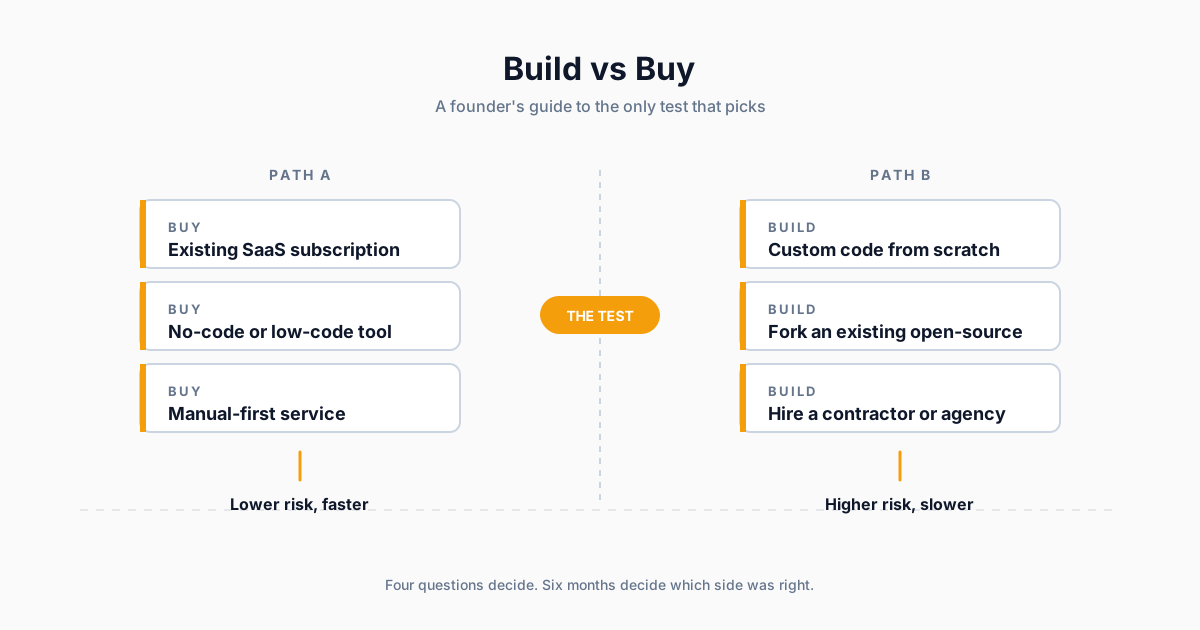
The Build-vs-Buy Decision for First-Time Founders: When to Ship Software, When to Pay for It, and the Only Test That Picks
A first-time founder's guide to the build-vs-buy decision — when to pay for an existing SaaS, when to assemble a no-code stack, when to fork an open-source project, when to hire a contractor, and when the only honest answer is to build from scratch. The four-question test that picks the right path, the five situations where the answer is pre-decided, and the six-month read-out that proves which side was right.
· 14 min read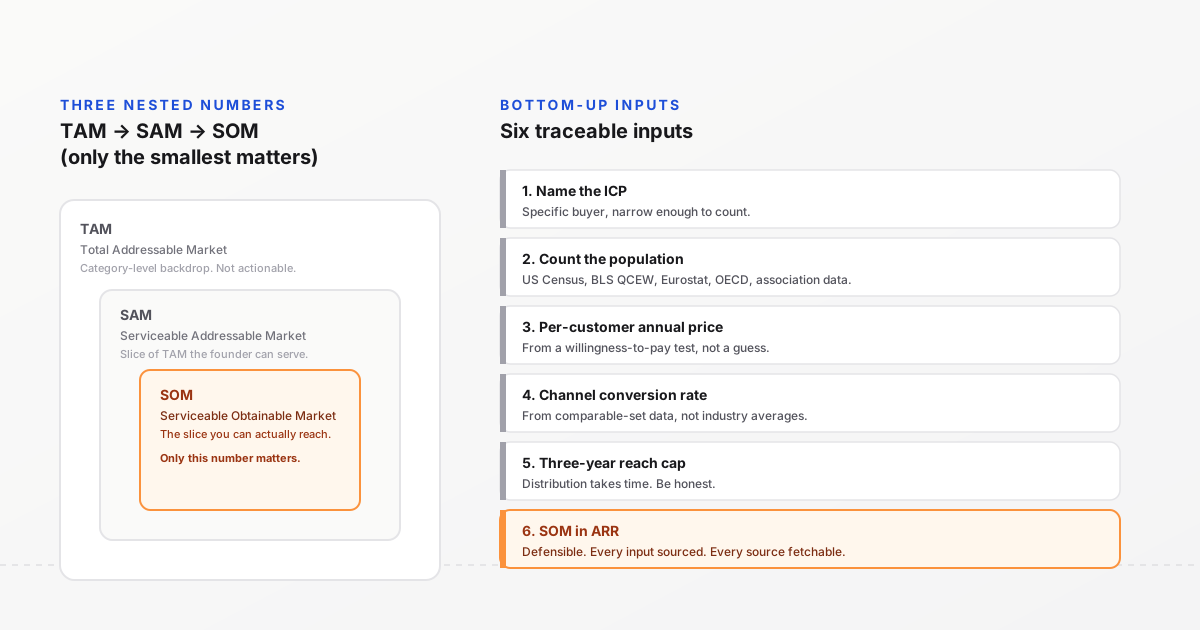
Validation Guide
How to Size a Market You Can Actually Reach: TAM, SAM, SOM, and the Two Numbers That Are Usually Useless
A founder's guide to estimating the market they can actually reach — what TAM, SAM, and SOM actually mean, why two of the three are usually useless for solo founders, how to do a defensible bottom-up sizing in a single afternoon, where to source the data, and the failure modes that produce a market-size claim a partner or investor will not trust.
· 16 min read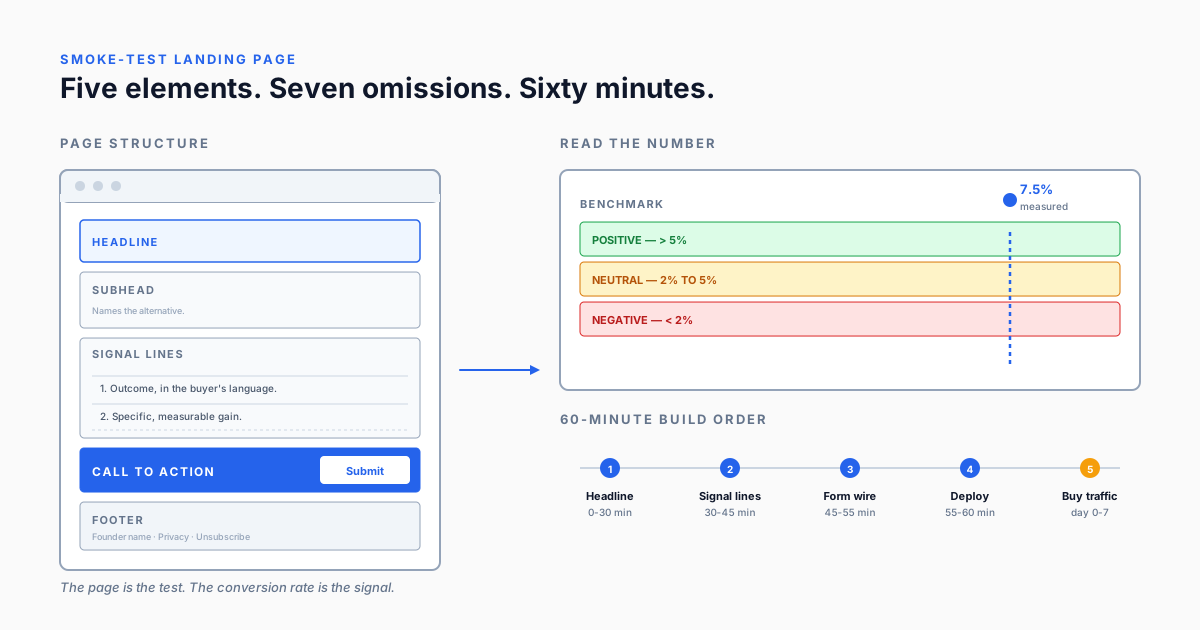
Validation Guide
How to Write a Smoke-Test Landing Page in 60 Minutes
The shortest path from a hypothesis to a real conversion number — page structure, headline formula, the four signal lines, the seven things to leave off, the 60-minute build checklist, and how to read the conversion data at small N.
· 14 min read
Stop spending 30 days building the wrong thing
Describe your idea, answer five short questions, and get a structured 7-dimension report — free, no signup.